
Detoxification and support for recovery
What is detoxification?
Detoxification is the process by which the body removes drugs or toxins and reduces their harmful effects. It involves:
- Metabolism: Breaking down the drug into metabolites (usually less active).
- Elimination: Removing these metabolites from the body through urine, feces, sweat, or
breath.
How Does Detoxification Occur?
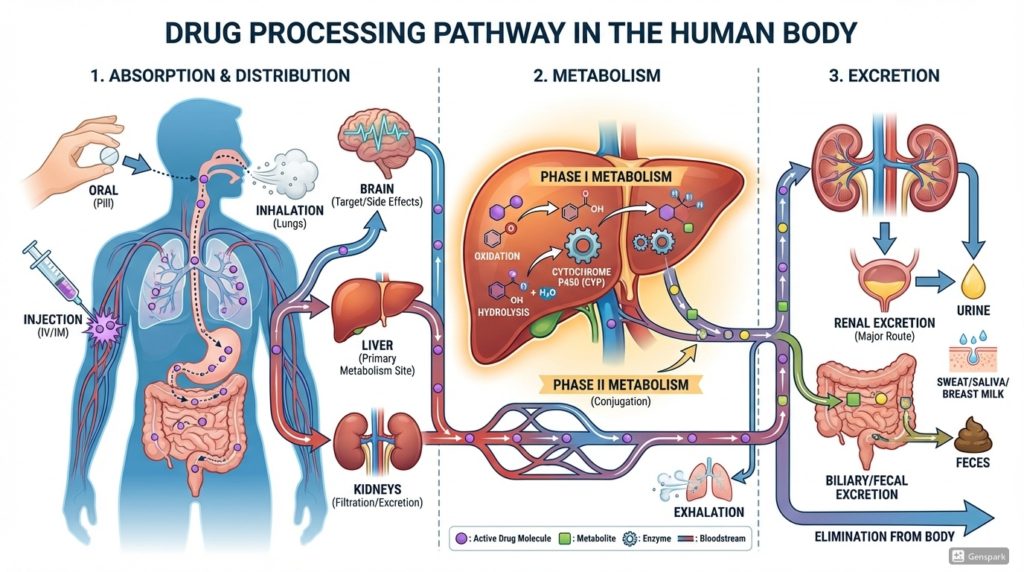
1. Absorption & Distribution
• After intake (swallowed, smoked, injected, or inhaled), the drug enters the bloodstream and is
carried to organs like
the liver, brain, and kidneys.
2. Metabolism (Mainly in the Liver)
- Phase I: Enzymes (e.g., cytochrome P450)
modify the drug through oxidation, reduction, or hydrolysis → often creates active or toxic
intermediates. - Phase II: These intermediates are
conjugated with molecules like glucuronic acid, sulfate, or glutathione → makes them
water-soluble and easier to excrete.
What is detoxification?
Detoxification is the process by which the body removes drugs or toxins and reduces their harmful effects. It involves:
- Metabolism: Breaking down the drug into metabolites (usually less active).
- Elimination: Removing these metabolites from the body through urine, feces, sweat, or
breath.
How Does Detoxification Occur?
1. Absorption & Distribution
• After intake (swallowed, smoked, injected, or inhaled), the drug enters the bloodstream and is
carried to organs like
the liver, brain, and kidneys.
2. Metabolism (Mainly in the Liver)
- Phase I: Enzymes (e.g., cytochrome P450)
modify the drug through oxidation, reduction, or hydrolysis → often creates active or toxic
intermediates. - Phase II: These intermediates are
conjugated with molecules like glucuronic acid, sulfate, or glutathione → makes them
water-soluble and easier to excrete.
3. Elimination
- Kidneys (Urine): Most metabolites are filtered out by the kidneys and excreted in urine.
- Bile & Feces: Some drugs are excreted via bile into the intestines and leave the body
in feces. - Other routes: Small amounts can leave through sweat, breath, or saliva.
How Does Detoxification Occur?
1. Absorption & Distribution
• After intake (swallowed, smoked, injected, or inhaled), the drug enters the bloodstream and is
carried to organs like
the liver, brain, and kidneys.
Factors Affecting Detoxification
- Drug type: Some (e.g., alcohol, opioids) are cleared faster than others (e.g., THC
from cannabis, which stays in fat cells longer). - Liver/kidney health: Damage slows down metabolism/elimination.
- Age, genetics, hydration, and metabolism rate: Influence how quickly drugs are
processed. - Polydrug use: Interactions can delay detox.
- Detoxification in Umeed-e-Shifa Rehab center.
- Medical supervision: Monitoring vitals, managing withdrawal symptoms, and providing
supportive care (hydration, nutrition)
Detoxification in Umeed-e-Shifa Rehab center.
- Medical supervision: Monitoring vitals, managing withdrawal symptoms, and providing
supportive care (hydration, nutrition). - Medications: To ease withdrawal (e.g., benzodiazepines for anxiety, anti-nausea meds, or MAT for opioids alternative for withdrawal, medicine tapering ).
- Therapy & counseling: Helps address psychological dependence while the body detoxes.
2. Metabolism (Mainly in the Liver)
- Phase I: Enzymes (e.g., cytochrome P450)
modify the drug through oxidation, reduction, or hydrolysis → often creates active or toxic
intermediates. - Phase II: These intermediates are
conjugated with molecules like glucuronic acid, sulfate, or glutathione → makes them
water-soluble and easier to excrete.
What is detoxification?
Detoxification is the process by which the body removes drugs or toxins and reduces their harmful effects. It involves:
- Metabolism: Breaking down the drug into metabolites (usually less active).
- Elimination: Removing these metabolites from the body through urine, feces, sweat, or
breath.
How Does Detoxification Occur?
1. Absorption & Distribution
• After intake (swallowed, smoked, injected, or inhaled), the drug enters the bloodstream and is
carried to organs like
the liver, brain, and kidneys.
2. Metabolism (Mainly in the Liver)
- Phase I: Enzymes (e.g., cytochrome P450)
modify the drug through oxidation, reduction, or hydrolysis → often creates active or toxic
intermediates. - Phase II: These intermediates are
conjugated with molecules like glucuronic acid, sulfate, or glutathione → makes them
water-soluble and easier to excrete.
3. Elimination
- Kidneys (Urine): Most metabolites are filtered out by the kidneys and excreted in urine.
- Bile & Feces: Some drugs are excreted via bile into the intestines and leave the body
in feces. - Other routes: Small amounts can leave through sweat, breath, or saliva.
Factors Affecting Detoxification
- Drug type: Some (e.g., alcohol, opioids) are cleared faster than others (e.g., THC
from cannabis, which stays in fat cells longer). - Liver/kidney health: Damage slows down metabolism/elimination.
- Age, genetics, hydration, and metabolism rate: Influence how quickly drugs are
processed. - Polydrug use: Interactions can delay detox.
- Detoxification in Umeed-e-Shifa Rehab center.
- Medical supervision: Monitoring vitals, managing withdrawal symptoms, and providing
supportive care (hydration, nutrition)
Detoxification in Umeed-e-Shifa Rehab center.
- Medical supervision: Monitoring vitals, managing withdrawal symptoms, and providing
supportive care (hydration, nutrition). - Medications: To ease withdrawal (e.g., benzodiazepines for anxiety, anti-nausea meds, or MAT for opioids alternative for withdrawal, medicine tapering ).
- Therapy & counseling: Helps address psychological dependence while the body detoxes.
What is detoxification?
Detoxification is the process by which the body removes drugs or toxins and reduces their harmful effects. It involves:
- Metabolism: Breaking down the drug into metabolites (usually less active).
- Elimination: Removing these metabolites from the body through urine, feces, sweat, or
breath.